


And 100% made in France
Awaken the hummingbird within you!
Free shipping on orders of €80 or more
When you run in winter, your winter running gear becomes almost as important as your shoes. If you’ve ever finished a run shivering with a soaked T-shirt clinging to your skin and numb fingers, you know that the wrong gear can ruin a session—or even demotivate you for several days.
The goal isn’t just to keep you warm. Good winter running gear should manage your sweat, allow you to move freely, protect your sensitive areas, and align with your values if you’re committed to a more sustainable lifestyle. That’s exactly where French manufacturing and recycled technical materials make all the difference.
You don’t need to pile on layers to stay comfortable outdoors. Above all, you need a well-designed winter running garment that can adapt to changes in your effort without turning you into an ice cube or a walking sauna.
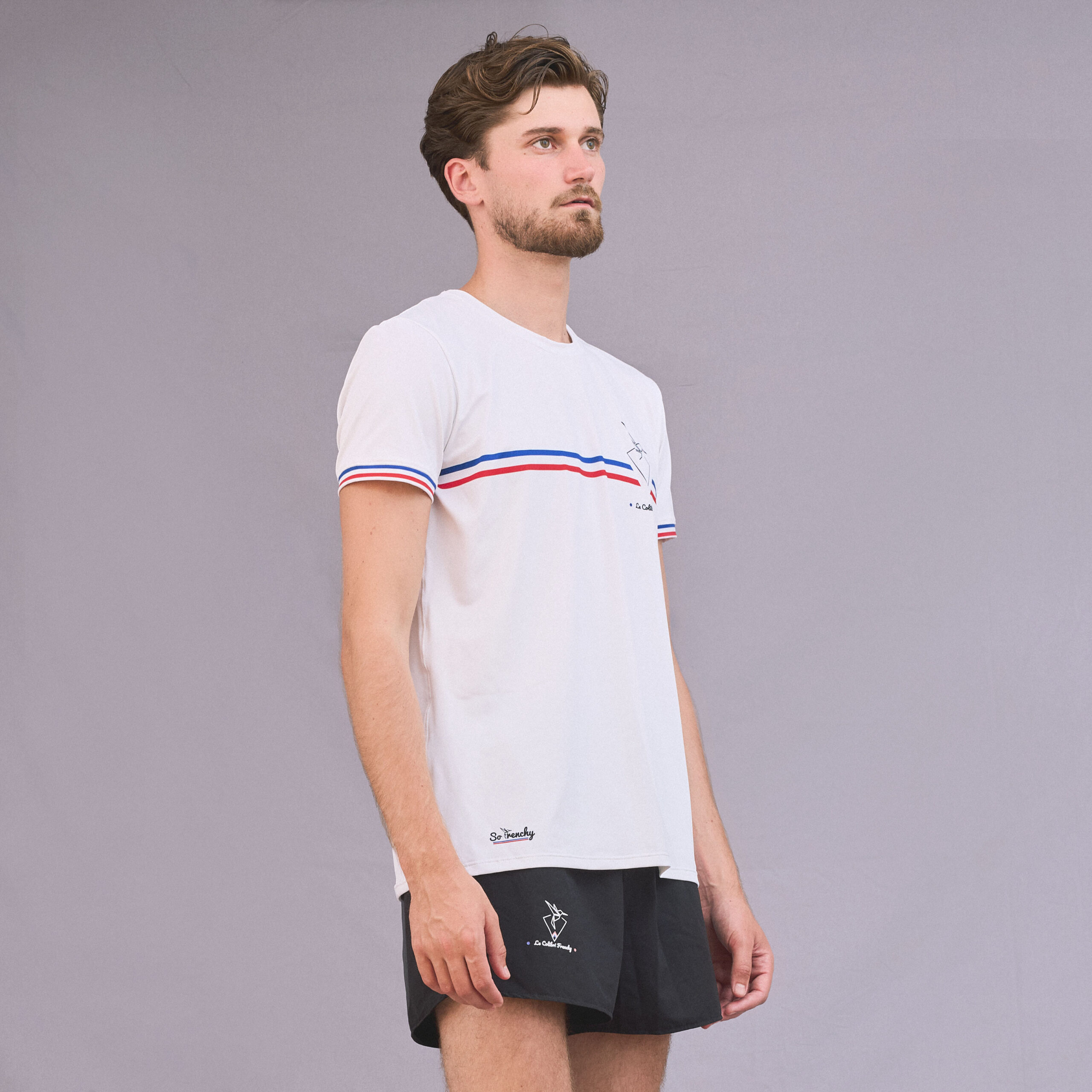
A technical winter running top must first and foremost manage sweat. Your body heats up quickly, even when the air is cold. If the fabric traps moisture, you’ll feel cold as soon as you slow down or the wind picks up. That’s why T-shirts like Le Pente Nord and Le 1886 are designed with sweat management in mind. Their lightweight, breathable fabric wicks away moisture as you exercise, while maintaining a thin layer of warmth close to the skin (Le Colibri Frenchy, Le Colibri Frenchy).
Comfort comes next. A poorly placed seam can be enough to chafe your skin after just a few kilometers. Le Pente Nord, for example, uses an innovative seam that’s soft and ultra-durable, specifically to prevent irritation during intense exertion, when your T-shirt rubs against the same spot hundreds of times (Le Colibri Frenchy). This concept of “invisible comfort” is essential. A good piece of winter running gear is one you stop thinking about during your run.
Finally, freedom of movement matters just as much as everything else. The cut should be athletic and fitted—neither too tight nor too loose—to follow your natural movements. The Le Pente Nord and Le 1886 models are designed to hug the body while allowing your arms and torso to move freely, which is especially nice during long runs or when you add an extra layer on top (Le Colibri Frenchy).
A good winter running top isn’t just “warm”—it’s dry, comfortable, and unobtrusive, to the point where you forget you’re even wearing it.
If you’re interested in where your clothes come from, you already know that not all fabrics are created equal—both technically and environmentally. When it comes to winter running gear, the choice of fabric has a real impact on your performance, comfort, and environmental footprint.
The Le Pente Nord and Le 1886 T-shirts are made of 92% recycled polyester and 8% spandex (Le Colibri Frenchy, Le Colibri Frenchy). This combination offers three key benefits for winter running.
First, recycled polyester is technical and lightweight. It dries quickly, doesn’t retain moisture like cotton, and retains heat when the air is cold. This means you stay in your thermal comfort zone longer, even in windy conditions or when stopping at a red light. Second, the spandex provides stretch. Your garment follows your every move—whether you’re running uphill, sprinting, or doing strength training after your run—without losing its shape or feeling constricting.
Finally, the manufacturing process for this recycled polyester reduces energy consumption by 64%, water use by 94%, and CO₂ emissions by 32% compared to conventional polyester (Le Colibri Frenchy, Le Colibri Frenchy). In practical terms, this means you can choose a high-performance winter running garment while significantly reducing your environmental footprint.
If you add accessories like the Le Montagnard fleece headband—made of 83% polyester and 17% spandex—you get targeted protection for your head and ears that remains breathable and lightweight, even on long runs or during winter interval training (Le Colibri Frenchy).
Choosing winter running gear made in France isn’t just a matter of pride. There are very tangible benefits behind this decision, both for you and for the planet.
The Le Pente Nord and Le 1886 T-shirts, as well as the Le Montagnard fleece headband, are entirely made in France, in the heart of the Auvergne Volcanoes (Le Colibri Frenchy, Le Colibri Frenchy, Le Colibri Frenchy). Their production journey doesn’t exceed 800 km, compared to about 40,000 km for a “traditional” imported T-shirt. Less transportation means a direct reduction in the carbon footprint associated with your running gear.
This local manufacturing also allows for better quality control. When design, cutting, and sewing are all carried out within a limited radius, the teams can fine-tune details, test products under real-world conditions, and continuously improve the final product. For winter running gear, these details are essential, since you demand more from your clothing when it’s cold, wet, or windy.
By choosing French sportswear, you’re also supporting the local economy and technical expertise. You’re encouraging brands that invest in textile innovation within the country, rather than in a race to the bottom on costs. If you value consistency between your athletic practice, your lifestyle, and your values, this factor carries significant weight.
There’s a lot of talk about sustainability, but winter running gear can also have a positive social impact. It’s an aspect you might not notice at first glance, but it matters if you want your purchases to make a difference.
Le Colibri Frenchy collaborates with ESATs and Adapted Enterprises to produce certain accessories, such as the Le Montagnard fleece headband (Le Colibri Frenchy). These organizations enable people with disabilities to engage in professional work within an adapted environment. In practical terms, every time you choose this type of product, you’re helping to create or sustain inclusive jobs.
This social dimension complements the concept of more responsible purchasing. You’re not just reducing the carbon footprint of your outfit or supporting a short supply chain. You’re also helping people gain training, find work, and reclaim their place in the professional world. For a simple piece of winter running gear, the impact is far from insignificant.
To get the most out of your winter running gear, it’s best to think of it as a system rather than individual pieces. A good winter outfit is a cohesive ensemble that manages heat, moisture, and protection for sensitive areas.
For example, you can pair a long-sleeve Le Pente Nord or Le 1886 T-shirt—as a breathable base layer—with a fleece accessory over the areas that lose the most heat, such as the head and neck. The Le Montagnard fleece headband effectively protects your ears without encasing your head like a thick beanie, which is handy if you tend to get hot quickly while running (Le Colibri Frenchy). To round out the look, Le Colibri Frenchy also offers a matching neck warmer and T-shirt from the Le Montagnard line, for a cohesive and high-performance outfit (Le Colibri Frenchy).
In practice, this results in a more stable running experience. You start out without shivering, you avoid a soaked T-shirt, and you keep your extremities at a comfortable temperature. As a result, you can focus better on your stride, your breathing, and your goals, instead of spending the entire session thinking about how uncomfortable you are.
How do I choose the right size for winter running gear?
For a technical top, you can generally choose your usual size. This is the case with the Le Pente Nord T-shirt, which features a fitted, athletic cut designed to optimize comfort and freedom of movement during winter runs (Le Colibri Frenchy
).
Is a long-sleeve T-shirt enough for winter running?
It all depends on the temperature, the wind, and how you feel. A technical T-shirt like the Le Pente Nord or the Le 1886 may be enough on its own in cool, dry weather. In colder conditions, it makes an excellent base layer under a lightweight windbreaker.
Why should you avoid cotton for winter running?
Cotton absorbs sweat and keeps it in contact with your skin. When you slow down or the wind picks up, that moisture cools you down very quickly. Technical fabrics made from recycled polyester dry much faster and minimize that damp, chilly feeling.
Is a fleece headband really more useful than a beanie?
If your head gets hot quickly while running, a headband like Le Montagnard is a good compromise. It protects your ears and forehead—areas that are very sensitive to the cold—while allowing the top of your head to breathe better. It’s ideal for intense winter workouts (Le Colibri Frenchy
).
In what way is a “Made in France” garment more sustainable?
A winter running garment made in France travels far fewer kilometers than an imported product—typically around 800 km compared to 40,000 km for a standard T-shirt. This reduces the carbon footprint associated with transportation and supports local jobs, while facilitating quality control and more transparent production practices (Le Colibri Frenchy
).
If you’re looking for winter running gear that goes beyond just a “warm T-shirt,” you’d be wise to check out technical pieces made in France from recycled polyester and designed for real-world use. With models like Le Pente Nord, Le 1886, and Le Montagnard fleece accessories, you combine performance, comfort, local manufacturing, and a reduced environmental impact—all while supporting social inclusion initiatives.
The next time you’re putting together your outfit for a run in cold weather, ask yourself this: Does this piece of clothing help me run better, stay true to my values, and support a more sustainable model? If the answer isn’t clear, it might be time to update your running wardrobe.
You can start exploring Le Colibri Frenchy’s technical T-shirts, headbands, and neck warmers right now, and build a cohesive, comfortable, and socially conscious winter outfit. Your future winter runs will thank you.


Directed by COQPIT - Communications Agency


