


And 100% made in France
Awaken the hummingbird within you!
Free shipping on orders of €80 or more
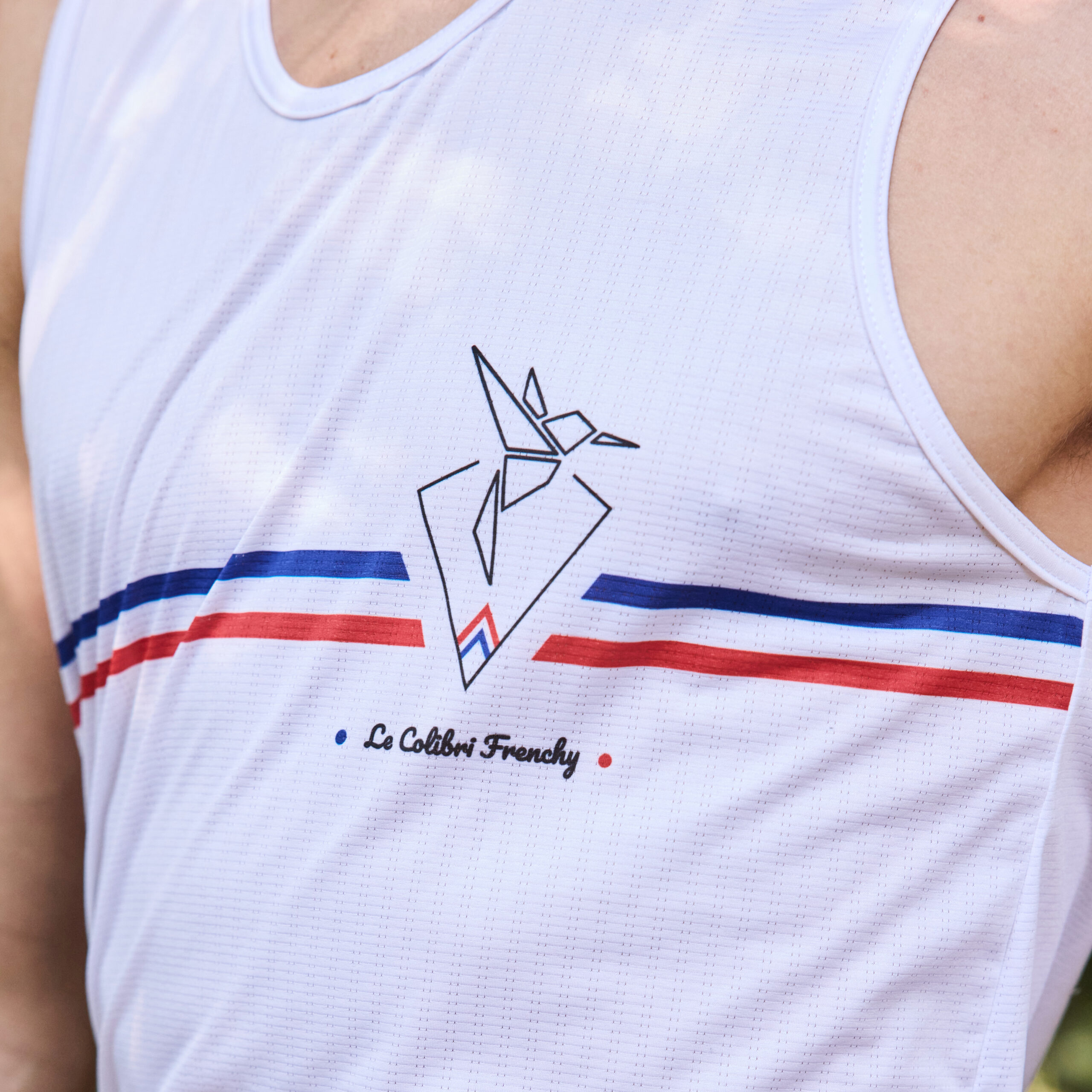
If you’re interested in “Made in France,” you’ve probably already searched for “French running brand” to find running gear that better aligns with your values. You want technical fabrics that keep up with your pace, but also locally made products that are more respectful of the planet and the people who bring it to life. The good news is that you can truly balance performance, style, and social responsibility by making smarter choices about what you wear while running.
In this article, you’ll learn exactly what goes into a running garment made in France—how it’s designed, why it can be more sustainable, and how to spot brands that are doing real, meaningful work, not just greenwashing.
When you choose a French running brand, you’re not just buying a technical T-shirt. You’re supporting a local ecosystem, reducing the distance your clothing has traveled, and benefiting from genuine textile expertise.
A brand like Le Colibri Frenchy manufactures all of its running apparel entirely in Auvergne. From design to production, everything takes place in France, which allows for strict quality control and true traceability. You know where the T-shirt was designed, where it was sewn, and by whom.
This proximity also changes the relationship you have with the brand. You can ask questions, learn about the materials, and seek clarification on the environmental impact. You’re no longer dealing with an elusive giant, but with a company that stands by its choices and can explain them.
Finally, a serious French running brand doesn’t just slap a blue-white-red flag on the label. It designs its clothing as a performance tool, incorporating real technical innovations—such as special ultra-soft, durable seams to prevent chafing during exercise—just like Le Colibri Frenchy does.
When you’re running, you don’t necessarily think about what’s behind the fabric of your T-shirt. Yet the choice of material is a huge factor in reducing the environmental impact of running gear.
Some French brands use recycled polyester made from plastic bottles, such as Le Colibri Frenchy, which designs technical T-shirts with a low environmental impact. You still get to enjoy the benefits of modern sportswear—quick-drying and breathability—while repurposing existing waste instead of producing new virgin material.
In models like the “Le Pente Nord – ML (F)” sports T-shirt, the fabric is made of 92% recycled polyester and 8% spandex to maintain the elasticity and comfort needed for running (Le Colibri Frenchy). According to studies cited by the brand, this approach significantly reduces energy consumption, water use, and CO2 emissions compared to conventional polyester.
You might not notice these numbers with every stride, but you’ll feel the lightness, the softness, and the way the fabric responds to sweat. And the difference is that you know this performance isn’t based on a highly polluting production model, but on a material designed to minimize its environmental footprint.
When you put on a simple sports T-shirt, it has often already traveled tens of thousands of kilometers—from the harvesting of the raw material, through spinning, dyeing, and manufacturing, all the way to your doorstep. A true French running brand, on the other hand, seeks to shorten that journey.
Le Colibri Frenchy’s products are made in the heart of the Auvergne Volcanoes, with a production supply chain of less than 800 km—whereas a standard T-shirt can easily exceed 40,000 km in cumulative transport distance. This difference in distance directly translates to a reduction in the carbon footprint associated with transportation.
This reasoning doesn’t apply only to T-shirts. The “Le Montagnard” sports headbands, designed for running and outdoor activities, follow the same local approach with 100% French manufacturing and a short supply chain (Le Colibri Frenchy). You don’t have to choose between performance and sustainability—you can simply decide that your next running accessory won’t travel three times around the globe before ending up in your drawer.
As a consumer, there’s one simple indicator to look for to help you make an informed choice: transparency about the production location. A true French running brand doesn’t hide behind a vague “designed in France”—it clearly states where it manufactures its products and with which partners.
Above all, running gear must perform well when you’re on the move. If the cut restricts your movements, if the seams chafe, or if the fabric traps moisture, you’ll know it right away. That’s where specialized running brands really set themselves apart.
Le Colibri Frenchy’s technical T-shirts feature an innovative seam, touted as the softest and most durable among the brand’s technical sportswear. The idea is simple: to guarantee you total freedom of movement without irritation, even during long runs or interval training sessions where every bit of chafing can become a problem.
Models like “Le Pente Nord – ML (F)” or “Le 1886 – ML (H)” also prioritize lightness—weighing just 110 g for the former—breathability, and effective moisture management thanks to a quick-drying fabric (Le Colibri Frenchy, Le Colibri Frenchy). These are details you notice most when you no longer have them—for example, when you put on an old cotton T-shirt that clings to your skin and makes you feel cold as soon as you start climbing.
Durability is also part of comfort. When a technical fabric withstands sweat and repeated washings while retaining its shape, you can wear it for entire seasons without seeing any pilling or seams coming apart. The brand’s customers specifically highlight the longevity and impeccable quality of its French-made running apparel, with comfort that remains consistent run after run (Le Colibri Frenchy).
Choosing a French running brand isn’t just about sustainability or style. It’s also a social act. By supporting local production, you help preserve jobs and local expertise. Some brands go even further by integrating inclusion into their business model.
Le Colibri Frenchy, for example, partners with an ESAT and an Adapted Enterprise to manufacture its T-shirts and headbands. These organizations support the professional reintegration of people with disabilities. So your athletic wear isn’t just “clean” from an environmental standpoint—it also supports a more open and inclusive society.
This type of partnership isn’t immediately visible on the garment itself, but it’s key information for understanding what you’re truly supporting when you buy your running gear. By reading the “About Us” and “Manufacturing” pages or the detailed product descriptions, you can easily identify this kind of commitment and make your purchasing decisions accordingly.
Maybe you run in a group—with a club, an organization, an informal team, or even your coworkers. In that case, you’ve probably heard of custom T-shirts. Often, they’re made on the other side of the world, with average quality and a fairly short lifespan. However, you can outfit your team with a French running brand without sacrificing customization.
For example, Le Colibri Frenchy offers custom sports T-shirts made in France for clubs, organizations, companies, or groups of friends who run together. You can either start with an existing design and add a logo, name, or slogan, or create a unique, custom design—with no minimum order quantity required, except for socks.
The process is designed as a collaboration. You work with designers, receive a mockup, approve it, and then production takes place locally, in line with the brand’s (Le Colibri Frenchy) commitments to quality, ethics, and environmental responsibility. For certain customizations, you simply need to allow for an additional lead time of a few weeks and a modest extra cost—for example, an additional €5 and 4 extra weeks of production time for certain customized T-shirts (Le Colibri Frenchy, Le Colibri Frenchy).
Several clubs, such as Team Caen Runners, have already made this choice and highlight the comfort, quality, and a design that truly reflects their identity, with professional support from start to finish (Le Colibri Frenchy). If you’re looking for a team uniform that makes a meaningful statement, this is a very practical option to explore.
Online, you’ll find plenty of promises and sometimes little proof. To be sure you’re running in a genuine French sports garment, you can rely on a few simple guidelines without getting lost in the technical details.
Start with the label and the product description. A garment made in France will clearly state this—not just “designed in France,” which doesn’t mean the same thing. Also check if the brand specifies the production location, partners, or workshops. When a company explains that it manufactures in Auvergne with a supply chain of less than 800 km—like Le Colibri Frenchy—it demonstrates transparency and control over the supply chain.
Next, take a closer look at the materials. Recycled polyester made from plastic bottles, blends with spandex to maintain elasticity, and cited studies on water or energy savings—all this information demonstrates genuine effort upstream to address environmental impact. You don’t need to become a textile engineer, but you can verify that there’s a logical rationale behind the brand’s choices.
Finally, read customer reviews with a keen eye on how well the clothing holds up over time. When several runners mention excellent resistance to sweat and repeated washings, as well as seams that stay in place, you can get a pretty accurate idea of the durability. This is what stands out in the feedback on Le Colibri Frenchy running apparel—a combination of comfort, style, and longevity that justifies the investment (Le Colibri Frenchy).
Is a French running brand necessarily more eco-friendly?
Not automatically, but it has more tools at its disposal
to reduce its environmental impact. Local manufacturing already limits transportation distances. If the brand also uses recycled materials—such as polyester made from plastic bottles—and optimizes its water and energy consumption, you end up with a garment that’s significantly more sustainable than average. So you have to look at the big picture: where it’s made and the choice of materials.
Why is the price often higher than for a traditional international brand?
Manufacturing in France costs more because wages, labor costs, and social standards aren’t the same as on the other side of the world. Added to this are higher-quality materials and more rigorous production processes. In return, you gain durability and comfort, and you support local jobs rather than a low-cost production model.
Is a running T-shirt made in France really more high-performance?
Performance depends mainly on the brand’s commitment to quality. A brand specializing in running that invests in textile research, like Le Colibri Frenchy, will focus on breathability, quick-drying properties, an ergonomic fit, and irritation-free seams. This level of attention to detail often makes all the difference on the trail compared to a generic sports T-shirt.
Is this suitable if I only run once or twice a week?
Yes, you don’t need to be training for a marathon to appreciate good technical apparel. Even if you run just twice a week, a breathable, lightweight, and durable T-shirt improves your comfort and saves you from buying multiple lower-quality pieces that wear out quickly. It’s also a simple way to align your sports budget with the values that matter to you.
How can I outfit an entire group or club with a French running brand?
You can turn to a brand that offers customization on garments made in France, such as Le Colibri Frenchy. The idea is to choose an existing technical model, add your group’s logo or colors, or even co-create a completely new design. You’ll just need to allow a little extra time for production, but you’ll end up with outfits that align with your identity and have a reduced environmental impact.
Every time you buy a piece of running gear, you’re voting for a certain type of production. You can turn a blind eye to the origin, the material, and the supply chain—or, on the contrary, decide that your kilometers should have meaning, both on the road and in the way your T-shirt was made.
A committed French running brand, like Le Colibri Frenchy, shows you that it’s possible to combine technical performance, comfort, style, local manufacturing, and respect for the planet. If you want to turn your intentions into action, start with a key piece of your athletic wardrobe—a T-shirt or headband made in France from recycled polyester, with true transparency about its production.
The next time you update your gear, ask yourself a simple question: Does this piece of clothing align with both my running practice and my values? Then explore the “Made in France” collections and customization options for your club or company, and turn your future runs into a concrete commitment to a more responsible way of gearing up.


Directed by COQPIT - Communications Agency


