


And 100% made in France
Awaken the hummingbird within you!
Free shipping on orders of €80 or more
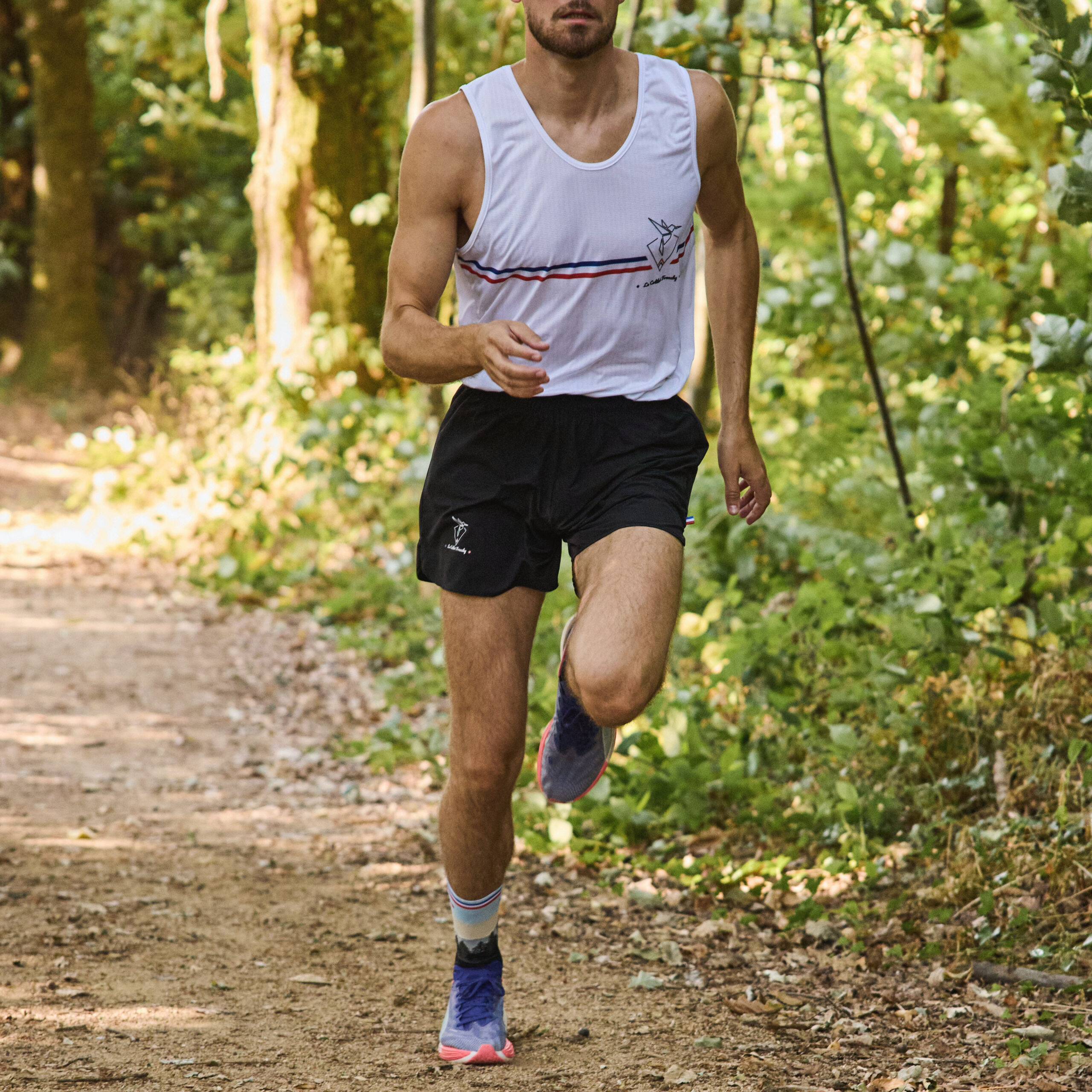
When you put on running gear, you’re not just looking for a cool T-shirt. You want to run light, breathe freely, avoid chafing, and—if possible—make a choice that makes a difference for the planet and the local economy. Your running gear then becomes a real secret weapon, an ally that’s with you session after session.
If you’re drawn to “Made in France” and wonder what’s really behind a French technical garment, you’ve come to the right place. You’ll see that a simple T-shirt can tell a story of performance, craftsmanship, and commitment.
A good piece of running gear is more than just a nice color or a logo. You should be able to forget you’re wearing it while you run, even on a long run or an interval workout. The fabric, cut, and finish all play a key role.
Modern technical fabrics, often made from recycled polyester blended with spandex, are designed to be lightweight, wick away sweat, and dry quickly. This is the case, for example, with Le Colibri Frenchy’s technical T-shirts, which use soft, breathable fabrics to keep up with you in both hot and cooler weather, offering a smooth, lightweight feel (Le Colibri Frenchy).
The cut is just as important as the fabric. Running gear should follow your movements without being too loose or too tight. A fitted, athletic cut helps prevent unnecessary chafing, especially under the arms, on the shoulders, or around the hips. You gain freedom of movement and waste less energy “managing” your clothes during your workout.
If you’ve ever finished a run with redness under your arms or around your neck, you know that seams can ruin a workout. It may seem like a minor detail, but it’s a key factor in your comfort.
Brands that take running apparel seriously, like Le Colibri Frenchy, rely on a special seam recognized as one of the softest and most durable in technical sportswear (Le Colibri Frenchy). The goal is simple: to ensure total freedom of movement without irritation, even when you’re racking up the kilometers or tackling intense workouts.
On models like the Le Pente Nord or Le 1886 T-shirts, this soft and ultra-durable stitching minimizes the risk of chafing over time (Le Pente Nord, Le 1886). You can wash and wear them repeatedly—the finish is designed to last. That’s where you see the difference between a simple “sports T-shirt” and a true technical running garment.
Choosing a running garment made in France isn’t just about patriotism or marketing. It has a tangible impact on the quality, traceability, and environmental footprint of what you wear.
A brand like Le Colibri Frenchy manufactures all of its technical running apparel entirely in France, in the heart of the Auvergne Volcanoes, showcasing local craftsmanship and supporting local jobs (Le Colibri Frenchy). The production chain is short—less than 800 km from design to the final product—compared to about 40,000 km for a typical imported T-shirt (Le Pente Nord). This means you significantly reduce the carbon footprint associated with transportation.
French manufacturing also facilitates quality control. Customer feedback has been very positive regarding color retention despite sweat and repeated washings, as well as the absence of blisters or uncomfortable chafing from their running socks—which demonstrates a genuine attention to detail and durability (Le Colibri Frenchy).
By making this choice, you’re also supporting a more transparent, ethical, and locally-sourced textile industry. If this is already an important value for you when it comes to food or cosmetics, applying it to your sports gear is a logical next step.
You don’t have to choose between performance and environmental commitment. The new generation of running apparel proves that it’s possible to combine the two, especially when the manufacturing process is reimagined from start to finish.
The Le Pente Nord T-shirt, for example, is made of 92% recycled polyester and 8% spandex, while remaining ultra-light—weighing just 110 g—and very comfortable for regular use during races or training (Le Pente Nord). This choice of recycled material reduces energy consumption by 64%, water use by 94%, and CO2 emissions by 32% compared to conventional polyester (Le Pente Nord).
The same principle applies to the Le 1886 T-shirt, made from 12 plastic bottles, which is lightweight, quick-drying, and offers good moisture-wicking properties (Le 1886). So you get true technical performance while giving plastic waste a second life.
This approach also extends to accessories. The “Le Montagnard” fleece sports headband is 100% made in France, with local production limited to within 800 km, in line with a sustainable fashion philosophy for committed athletes (Le Montagnard). As an added bonus, Le Colibri Frenchy collaborates with an ESAT and an Adapted Enterprise, which helps facilitate the professional reintegration of people with disabilities (Le Montagnard). Your purchase therefore has a real social impact, beyond just athletic performance.
Choosing your running gear becomes a concrete way to align your values, comfort, and performance—without sacrificing one for the other.
If you run with a club, an organization, or a group of friends, you know how much a matching outfit strengthens team spirit. Customization isn’t just about style—it’s also a way to boost motivation and a sense of belonging.
Le Colibri Frenchy offers customization of sports T-shirts made entirely in France, tailored for sports clubs, organizations, companies, or groups of friends who want to run in matching colors (Customization). The process goes beyond simply printing a logo; it includes co-design with graphic design experts, the creation of mockups, and local manufacturing that meets high standards of quality, durability, and ethics (Customization).
There is no minimum order quantity required to customize sports apparel, except for socks, for which direct contact is necessary (Customization). This allows a small group of friends or a new organization to get outfitted without having to order massive quantities. Teams such as Team Caen Runners, Team WTF, and Team USGA also highlight the comfort, design, quality, and fast delivery of their customized apparel (Customization).
For certain models, such as Le Pente Nord or Le 1886, you can request customization with an additional lead time of about 4 weeks and a modest surcharge of 5 euros—which is still a great deal for getting a piece that truly reflects your style (Le Pente Nord, Le 1886).
To turn your T-shirt into a true secret weapon, you can follow a few simple guidelines. First, check the fabric composition and opt for breathable technical fabrics—preferably recycled—that dry quickly and don’t trap moisture. Next, look at the fit—a sporty, fitted cut will provide good support without restricting your movement.
Pay special attention to the seams. A model featuring soft, flat seams—or seams specifically designed to prevent chafing, like those on Le Colibri Frenchy—will serve you well as you ramp up your training volume. For runs in cold or windy weather, a lightweight long-sleeve T-shirt like Le Pente Nord or Le 1886—possibly paired with a headband like Le Montagnard—offers a good balance between protection and breathability.
Finally, if you identify with the values of “Made in France” and responsible manufacturing, look for brands that actually manufacture in France and clearly explain their choice of materials, their partners, and their commitments. If you’d like to explore this topic further, you can also take a broader look at French sportswear to compare different approaches.
Is “Made in France” running apparel necessarily more expensive?
Often, the price is slightly higher than that of a low-cost imported product, because you’re paying for local labor, more closely monitored production, and materials that are often higher quality—or even recycled. On the other hand, their durability and comfort mean you won’t need to replace them as often, which can be more cost-effective in the long run.
Are recycled fabrics just as high-performance as conventional fabrics?
Yes, when they’re well-made. Le Colibri Frenchy’s technical running T-shirts, made from 92% recycled polyester and 8% spandex, remain lightweight, comfortable, and high-performance, while significantly reducing their environmental impact compared to conventional polyester (Le Pente Nord
, Le 1886
).
How can you tell if a garment is truly made in France?
Look beyond the simple “Designed in France” label. Transparent brands specify 100% French manufacturing, production locations, local partners, and even the distance traveled. Le Colibri Frenchy, for example, details how its garments are made in the heart of the Auvergne Volcanoes and highlights a local supply chain of less than 800 km (Le Colibri Frenchy
).
Is it worth customizing a running T-shirt?
If you run alone, it’s not essential. But for a club, organization, company, or group of friends, customized gear boosts team spirit and visibility at races. The ability to co-design the look with graphic designers—as at Le Colibri Frenchy—allows you to achieve a unique result that truly reflects your group (Customization
).
Does a sports headband really make a difference during a race?
Yes, especially in cold or windy weather. A lightweight headband like Le Montagnard, made of polyester and spandex, protects your ears and forehead, keeps you from feeling cold, and helps manage sweat on your head, all while remaining comfortable and stretchy (Le Montagnard
).
Your next piece of running gear can be so much more than just a T-shirt. By choosing a technical, well-tailored piece—made in France and built to last—you’re investing in your comfort, your performance, and your values. You’ll run more freely, minimize chafing, reduce your environmental impact, and support authentic local craftsmanship.
If you’re ready to take action, explore the Made in France technical apparel and accessories offered by Le Colibri Frenchy, from recycled long-sleeve T-shirts to lightweight, high-performance sports headbands. Choose the piece that suits you best—in a standard or customized version—and make your next piece of running gear your new secret weapon on every run.


Directed by COQPIT - Communications Agency


