


And 100% made in France
Awaken the hummingbird within you!
Free shipping on orders of €80 or more
French sports brands are becoming increasingly popular among discerning runners. Those who go on back-to-back runs and trail sessions are no longer satisfied with just a logo on a piece of branded sportswear. They’re looking for technical fabrics that breathe, stand the test of time, and are part of a local and responsible approach. This trend is particularly evident in accessories—such as arm sleeves, running socks, and running T-shirts—which are put through their paces on the trail.
In this context, French sports brands occupy a unique position. They combine textile expertise, technical innovation, and local manufacturing. For runners accustomed to seeing their standard gear wear out after a few months, this approach tangibly transforms the experience, whether on the road or on the trail.
Regular runners and trail runners know from experience what doesn’t work. Seams that chafe after 10 km, socks that develop holes after just a few runs, and fabrics that become saturated with sweat during a slightly longer climb or an interval training session. They eventually identify very specific criteria for their running apparel and accessories.
Above all, they expect four key elements from French sports brands. First, true technical performance with breathable materials, quick-drying properties, precise support, and a cut that moves with the body. Second, genuine durability. A sports T-shirt, a pair of arm sleeves, or socks must retain their properties after several months—or even years—of use. Next comes ethical and environmental consistency. More and more runners want their recycled sportswear or “Made in France” sportswear to have a reduced impact on the planet. Finally, they seek fair value for money, commensurate with technical quality and local manufacturing.
Major international brands partially meet these expectations, but disappointment often stems from rapid wear and tear or marketing claims that don’t always hold up in real-world conditions. French sports brands stand out precisely where runners have the keenest eye.
Discerning runners aren’t just talking about style when they compare sportswear brands. They’re interested in material choices, stitching techniques, the fabric’s breathability, and its ability to manage sweat during prolonged exertion.
A concrete example is the technical T-shirts designed by Le Colibri Frenchy. The brand develops athletic T-shirts with a specific stitching technique, known for being particularly soft and durable, to prevent chafing even during prolonged exertion (Le Colibri Frenchy). For a runner who alternates between road marathons and mountain trail runs, this attention to detail directly translates to less chafing, less redness, and therefore greater focus on the workout.
The L’Isard sports T-shirt is a prime example of this high standard. It’s made from 92% recycled polyester and 8% spandex, allowing it to combine lightness, elasticity, and moisture-wicking properties. The fabric dries quickly, wicks away sweat, and helps prevent the feeling of cold during descents or recovery periods (Le Colibri Frenchy). For a rider transitioning from a steep climb to a windy plateau, these details make a noticeable difference in comfort.
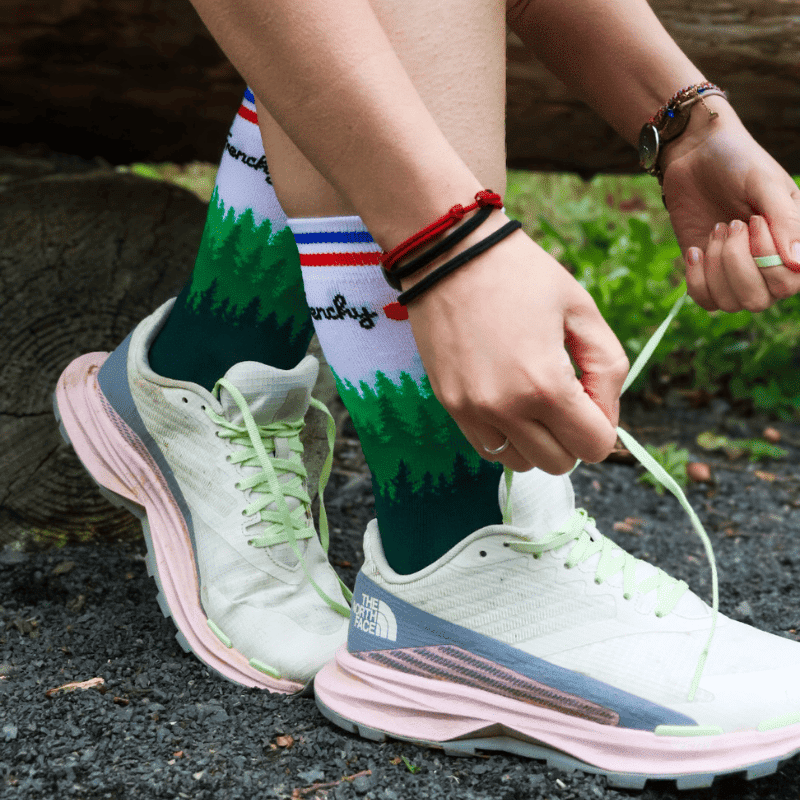
Sunset sports socks, also designed and manufactured in France, aim for the same balance between technical performance and comfort. They’re designed for foot thermoregulation, moisture-wicking, and lightness, while remaining sturdy enough to withstand repeated use and changes in terrain (Le Colibri Frenchy). This directly addresses the frustration of runners who see their standard socks wear out at the heel and toes after just a few weeks.
One of the things that sets French sports brands apart is their regional roots. Sportswear made in France isn’t just a marketing pitch—it has very concrete implications for carbon footprint, traceability, and relationships with local workshops.
Le Colibri Frenchy, for example, is a brand from Auvergne that manufactures all of its technical apparel entirely in France. The products are designed and crafted in the heart of the Auvergne Volcanoes, which helps showcase 100% French craftsmanship while supporting local jobs (Le Colibri Frenchy). For runners who want their French sportswear to also reflect a sense of commitment, this aspect matters just as much as pure performance.
The brand also minimizes the distances its products travel. Fleece headbands, for example, travel less than 800 km from the factory to the point of sale—a far cry from the tens of thousands of kilometers traveled by an accessory produced on the other side of the world (Le Colibri Frenchy). For Sunset socks, this distance drops to less than 300 km between the production site and the point of sale (Le Colibri Frenchy). The result is a significantly reduced carbon footprint, in line with the expectations of runners who are mindful of eco-friendly sportswear.
The issue of materials is just as crucial. The L’Isard T-shirt, made from recycled polyester, exemplifies an eco-friendly approach that reduces energy consumption by 64%, water use by 94%, and CO2 emissions by 32% compared to conventional polyester (Le Colibri Frenchy). For a runner seeking eco-friendly sportswear, this type of technological choice is crucial.
French sports brands that appeal to discerning runners don’t stop at environmental considerations alone. They often embrace a strong social mission, whether through how they organize their production or the partnerships they develop.
Le Colibri Frenchy works closely with an ESAT and an Adapted Enterprise to manufacture its technical T-shirts, headbands, and socks. This collaboration promotes the professional reintegration of people with disabilities and positions the brand within an inclusive economy (Le Colibri Frenchy). For runners who think carefully about the impact of their purchases, it’s important to know that their French sports brand supports local employment and social inclusion.
This commitment is also reflected in the choice of materials for the Le 1886 hoodies, which are made from organic cotton. Production follows a short supply chain—limited to less than 250 kilometers—and once again involves an ESAT and an adapted enterprise in the Auvergne-Rhône-Alpes region (Le Colibri Frenchy). Even the shipping envelopes are made from 100% recycled and recyclable materials, extending this commitment down to the smallest detail.
This type of positioning resonates particularly strongly with athletes who want to align their choices of “Made in France” sportswear with their personal convictions. For them, supporting a “Made in France” sports brand that combines performance, responsibility, and social commitment is a natural extension of their approach to consumption.
Discerning runners—whether they belong to a club, an association, or a trail running team—often want to go beyond simply purchasing standard sportswear. They’re looking for a French trail running brand or a French running brand capable of offering customized outfits that reflect their identity and team colors.
Le Colibri Frenchy offers a comprehensive customization service for sports T-shirts, sweatshirts, and socks. The customized sports T-shirts are designed locally, with a commitment to ethical and eco-friendly practices, and the graphic design process involves collaborating with designers who create an initial mockup and then refine the design with the client (Le Colibri Frenchy). This may involve adding a logo to an existing design or creating a completely unique design, with no minimum order quantity required—except for socks.
This close collaboration is reflected in feedback from the field. Several clubs, such as Team Caen Runners, Team WTF, and Team USGA, highlight the quality of the fabrics, the comfort, the accuracy of the design, and the brand’s responsiveness when creating their custom outfits (Le Colibri Frenchy). For a group of runners preparing for an ultra-trail race or a major road race, being able to communicate directly with a French running brand and obtain outfits tailored to their actual needs creates a relationship that’s different from the one they’d have with a large, anonymous retailer.
The customization of “Made in France” athletic socks works on the same principle, with delivery times generally ranging from 4 to 6 business days—a timeline that aligns well with preparing for an event or a club season (Le Colibri Frenchy). This ability to respond quickly and precisely to demand is often cited as a major advantage by regular runners.
For many runners, switching to a French sports brand means partnering with a trusted technical partner, rather than simply a supplier of equipment.
Given the growing number of French sports brands on the market, it can be helpful to approach your decision-making process systematically. Regular runners would be wise to analyze their actual needs before focusing on a sports apparel brand’s logo or current trends.
The first step is to identify the items where technical performance is most critical. For a trail runner, socks, running T-shirts, and protective accessories like fleece headbands or arm sleeves deserve special attention. These items directly determine comfort during long hours of running. Runners can then compare these needs with the brands’ commitments to “Made in France” sportswear and recycled sportswear.
It’s also important to consider the brand’s overall consistency. A true French sports brand that prioritizes short supply chains, local manufacturing, and recycled materials—while collaborating with social integration organizations—demonstrates a level of commitment that goes beyond a simple capsule collection. For example, Le Colibri Frenchy’s product descriptions detail the distances traveled by each item, the percentage of recycled materials, and the partners involved in manufacturing. This gives runners the information they need to make an informed choice.
Finally, the experiences of other athletes remain a valuable resource. Testimonials from clubs, teams, or running groups that have already adopted a French sportswear brand serve as a concrete indicator of durability and real-world comfort.
Are French sports brands really more durable than major international brands?
Durability depends primarily on the choice of materials, design, and manufacturing processes. Many French sports brands, such as Le Colibri Frenchy, rely on high-quality technical fabrics, reinforced seams, and controlled local production, which tends to improve the garment’s longevity compared to more standardized products.
How is a sports T-shirt made in France different for a regular runner?
Running apparel made in France often benefits from better quality control and clearer traceability. In the case of the L’Isard T-shirt, runners benefit from a recycled fabric, a cut designed for movement, and soft seams that minimize irritation—a difference you’ll notice right from your first long runs.
Are eco-friendly products just as high-performance as traditional ones?
Recycled textiles and eco-friendly approaches have come a long way. For example, the recycled polyester used by Le Colibri Frenchy maintains lightness, elasticity, and quick-drying properties while significantly reducing the environmental impact (Le Colibri Frenchy
). For a discerning runner, there’s no longer really a trade-off between performance and sustainability.
Does customizing apparel affect the technical performance of the products?
When done directly by a sportswear brand that controls its own production, customization does not compromise the product’s performance. T-shirts, sweatshirts, and socks customized by Le Colibri Frenchy retain their technical characteristics, as the base fabric remains identical to that of standard models; only the graphic design changes.
Why should runners consider short supply chains for their gear?
Choosing sportswear made in France through short supply chains reduces the carbon footprint associated with transportation and supports skilled local jobs. For runners who spend a lot of time in nature—whether on the road or on trails—it makes sense to prioritize brands with a controlled environmental and social impact.
Today, French sports brands offer discerning runners a credible and solid alternative to major international brands. They combine technical materials, comfort, durability, local manufacturing, and environmental and social commitment. Products like the L’Isard T-shirt, Sunset socks, or Le Colibri Frenchy fleece headbands show that it’s possible to balance racing performance with social and environmental responsibility, without sacrificing the pleasure of wearing well-designed technical sportswear.
For regular runners and trail runners looking to take their game to the next level, now is the perfect time to explore the world of French sports brands. They might start with a sports T-shirt, a pair of socks, or a technical sweatshirt, then gradually expand their collection of Made in France athletic wear. They can take the time to compare options, test them in the field, and notice the differences during their runs.
They can discover the approach of Le Colibri Frenchy, an Auvergne-based brand that’s 100% made in France and combines textile innovation, short supply chains, recycled materials, and a strong social commitment (Le Colibri Frenchy). Whether it’s a runner’s T-shirt, a running T-shirt, or custom trail running socks, they have the option to choose gear that’s good for their bodies, their sport, and the environment.


Directed by COQPIT - Communications Agency


