


And 100% made in France
Awaken the hummingbird within you!
Free shipping on orders of €80 or more
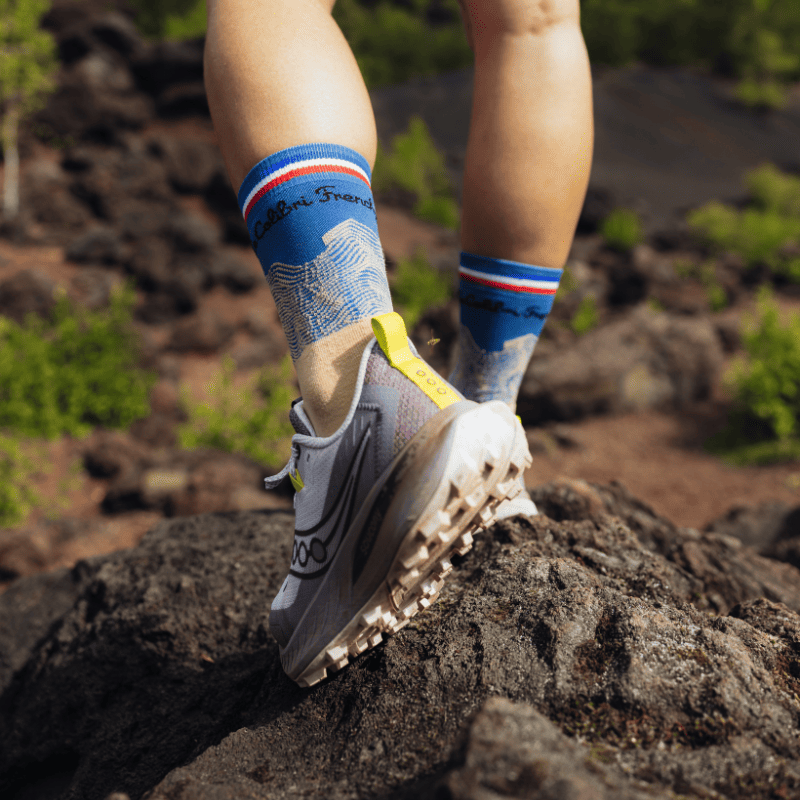
This article is for trail runners and road runners who are wondering whether a pair of performance socks made in France is really worth the investment—and for those who have already suffered from blisters because they chose the wrong pair.
Socks are the most often overlooked piece of gear when preparing for a trail run. They’re also the one item that can turn a great run into a nightmare—or, conversely, allow you to finish a 50-km race without the slightest irritation. It’s the little things that make all the difference.
A technical trail running sock serves several purposes at once:
Moisture-wicking: Sweat from the foot is transported to the outside of the sock, away from the skin. Without this property, moisture builds up, the skin becomes softened, and blisters form.
Support: A well-designed sock conforms to the shape of the foot and stays in place during running. A sock that slides around inside the shoe causes friction, which is a direct cause of blisters.
Targeted cushioning: Areas subject to repeated impact—the heel and forefoot—feature additional padding. On technical and rocky terrain, this cushioning reduces fatigue and protects the tendons.
Abrasion resistance: The areas that rub against the shoe (toe, sides, heel) are reinforced to withstand the hundreds of thousands of friction cycles of a long run.
Le Colibri Frenchy socks are made in Limousin, in a workshop that specializes in technical knitwear. The entire production process—from raw material to finished sock—covers no more than 800 kilometers.
This proximity to the manufacturing site has tangible effects on the product:
Immediate quality control: Any mesh irregularities can be quickly identified and corrected, without delays caused by intercontinental communication. Consistency from one pair to the next is guaranteed.
Responsiveness to feedback from the field: When runners report a problem area or poor fit, the workshop can adjust the knitting program within a few weeks. Major international brands have product development cycles of 12 to 18 months.
Locally Sourced Materials: The technical yarns used (polyamide, spandex, polypropylene) are selected in collaboration with our French partner workshops based on their specific properties suited to trail running needs.
A high-quality trail running sock features reinforcements in key areas. Here are the most important ones:
Heel reinforcement: the area at the back of the foot most exposed to impact and friction. A dense reinforcement significantly extends the sock’s lifespan.
Forefoot reinforcement: protects the toes and forefoot during impacts on descents. Essential on technical terrain.
Ventilation panels: Located on the top of the foot and sometimes under the arch, these panels (areas with a more open weave) allow for optimal airflow. They keep the foot cool in the summer and prevent the skin from becoming soft.
Toe and instep: A flat seam at the toe prevents the typical pressure point found in socks with raised seams—a common cause of blisters on the tips of the toes.
Short socks (ankle socks): reach just past the ankle. Lightweight and breathable, they’re ideal for short trail runs and summer runs on fast-paced trails. Be careful of friction between your ankle and shoe on downhills.
Mid-calf socks: the versatile choice for most trail runners. They protect the Achilles tendon and lower calf from chafing without adding significant bulk.
Knee-high socks (3/4 or full-length): provide calf support and reduce muscle vibration during long-distance runs. Popular for ultra-trails and runs lasting several hours.
Technical socks wear out quickly if not cared for properly:
With proper care, a pair of high-quality trail running socks can last for several hundred runs before showing significant signs of wear.
A technical trail running sock made in France costs more than a generic sock. That’s a fact.
But when you look at the cost per use, the math changes quickly. A well-maintained performance sock lasts for 200 to 300 outings. Divide the purchase price by that number and compare it to a cheap sock that wears out after 50 outings. Investing in quality pays off—not to mention that it’s more comfortable and more environmentally friendly.
How do you choose the right size for your trail running socks? Trail running socks are generally ordered in your usual shoe size. If you’re unsure between two sizes, go with the larger size: a sock that’s too tight will squeeze your toes and cause friction. A sock that’s slightly too big will stay in place in your shoe as long as it has good elastic support.
Can you wear trail running socks for road running? Yes, absolutely. Trail running socks are designed for intense exertion and varying terrain. They work perfectly on roads, trails, or cross-country courses. The reinforced areas and moisture-wicking features are useful regardless of the terrain.
Do you need different socks for summer and winter? Ideally, yes. In the summer, opt for lightweight socks with ventilation panels. In winter, slightly thicker socks (higher weight) or merino wool socks provide extra thermal insulation while still managing moisture.
Discover the line of trail running socks made in France by Le Colibri Frenchy: technical, lightweight, and made in the Limousin region.


Directed by COQPIT - Communications Agency


